


Reduce energy for humidity and climate control in agrifood facilities while protecting product quality
Savery’s Thermal Transformer Modules dehumidify, heat and cool agrifood facilities in a single loop. They remove latent load at high efficiency, reuse low‑grade heat and stabilise dew point and VPD, so cold rooms frost less, greenhouses vent less and process climates stay tight with lower energy and CO₂.

Cold storage and cold logistics
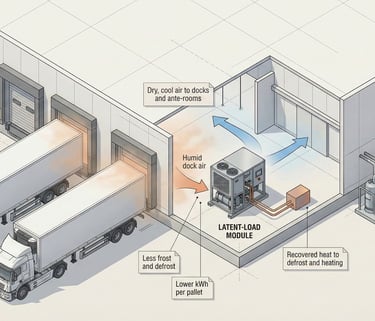
Refrigerated warehouses and cross‑docks lose energy every time a door opens. Humid air rushes in, turns into frost and drives defrost cycles, safety issues and product damage. Savery adds a dedicated latent‑load engine around docks and ante‑rooms. Infiltration air is dried through a sorption heat‑pump module, so the main ammonia or CO₂ plant focuses on sensible cooling under much more stable conditions.

Key benefits
Lower latent energy and defrost
Targeted dehumidification of dock and buffer zones saves defrost and latent cooling energy without changing temperature setpoints.
Safer, more reliable operation
Less frost on floors and evaporators, fewer manual interventions, more predictable uptime for critical cold chain links.
Better performance metrics in tenders
Lower kWh per pallet and CO₂ per tonne·km are documentable advantages when bidding with major food brands and retailers.
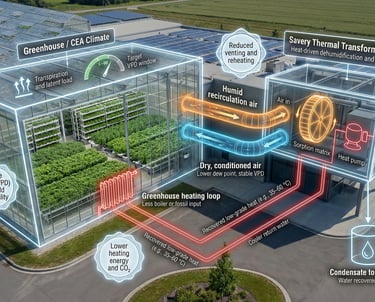
Greenhouses & controlled‑environment agriculture: dehumidification without “heat and vent”
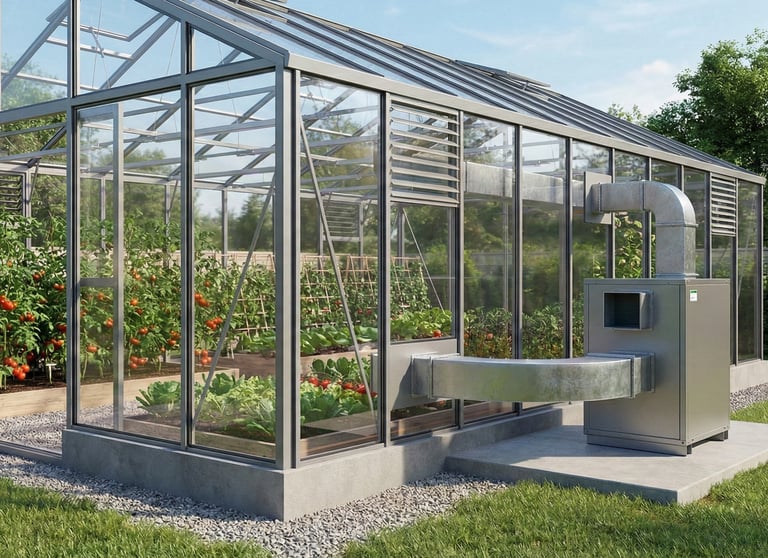
Greenhouses and CEA facilities juggle dense canopies, strong radiation and tight VPD targets. Traditional “heat and vent” throws away warm, CO₂‑rich air to control humidity. Savery inserts a sorption heat‑pump module into the climate loop. Internal air is recirculated, dehumidified and its latent heat is recycled into the heating network, so growers reduce heating demand, CO₂ loss and water waste while keeping VPD exactly where crops need it.
Key benefits
Lower heating demand at tight VPD
Humidity is removed through a high‑COP thermal cycle, which removes thermal losses, especially in cold and humid climates.
Closed or semi‑closed climate with CO₂ and water savings
Less venting means more effective CO₂ dosing and less loss of irrigation water, which supports closed nutrient and water cycles.
Yield, quality and disease control
Stable dew point and VPD reduce fungal diseases and allow more aggressive climate recipes for higher yield and better quality.
Dairy plants: precise humidity with integrated heat recovery
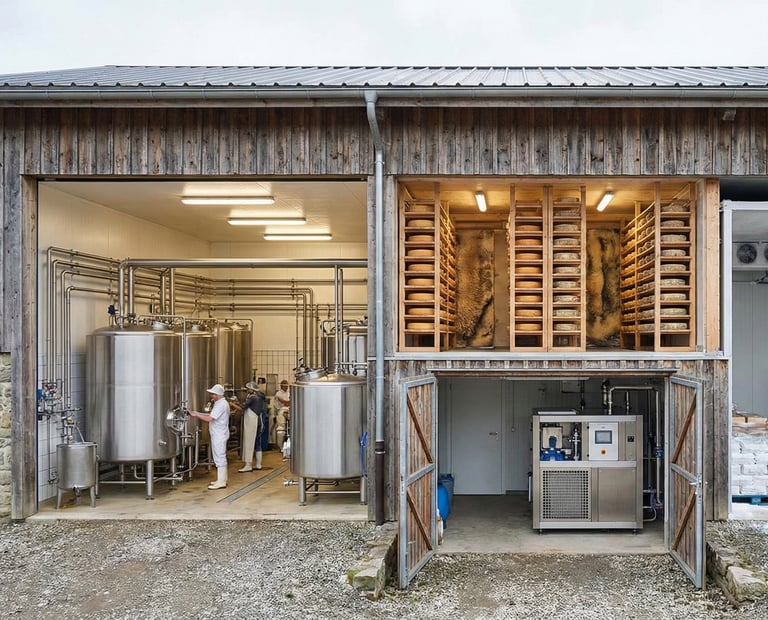
Dairy plants combine hot, humid zones (fermentation rooms, spray dryers) with cold, condensation‑prone areas (storage, packaging, maturation). Conventional coils, ventilation and local heaters often lead to condensation risks, high steam use and patchy humidity control. Savery’s sorption heat‑pump modules couple these zones. They dehumidify cold spaces without brute over‑cooling and reheating, and recover heat and water from warm exhaust streams to feed useful hot‑water loops.

Key benefits
Energy and CO₂ reduction across zones
Less steam or gas is needed for drying and reheating. Low‑grade heat sources, including process exhausts, are upgraded and reused.
Improved hygiene and compliance
Condensation on ceilings, pipes and packaging is reduced. Cold rooms and maturation chambers stay in stable, hygienic (T, RH) ranges.
Quality and flexibility
Maturation rooms and drying zones follow more precise humidity trajectories, improving yields and allowing product‑mix changes without climate reengineering.
Livestock and poultry: drier barns with less fuel and less NH₃.
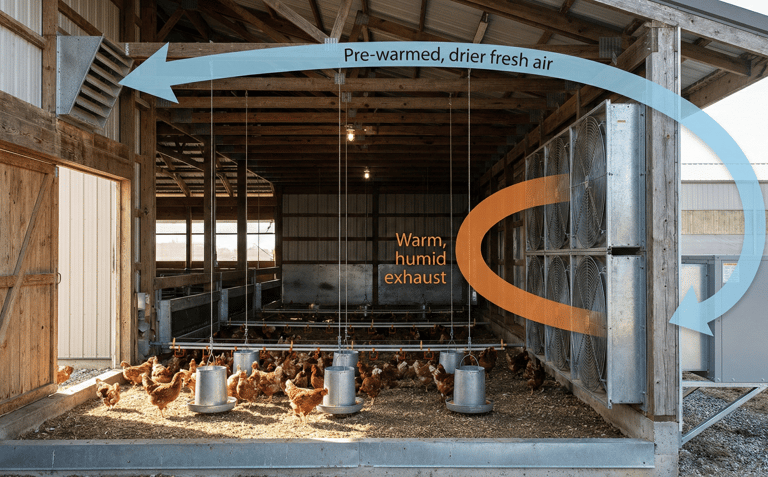
Mechanically ventilated barns must remove heat, moisture and ammonia while keeping animals comfortable. In winter, high ventilation rates mean large heat losses and high fuel bills, even with basic heat recovery. Savery adds a thermal‑based dew-point stabiliser at the ventilation interface. Exhaust air is dried and its latent and sensible heat are recovered, then used to preheat and condition incoming fresh air. The barn runs at moderate RH with drier litter and reduced ammonia.
Key benefits
Lower heating energy at the same ventilation rate
Recovered latent and sensible heat warms incoming air, reducing fossil fuel or electric heating demand.
Better animal welfare and performance
Drier litter, lower NH₃ concentration and more stable temperatures support improved growth, feed conversion and lower mortality.
Environmental and regulatory gains
Reduced NH₃ and particulate emissions help meet environmental targets and ease local acceptance.
Curing rooms: programmable humidity trajectories with less waste
Affinage cellars and charcuterie drying rooms are governed by humidity as much as by temperature. Today many run on basic coolers, heaters and simple humidifiers, which give non‑uniform drying, condensation in awkward spots and high energy bills. Savery turns humidity into a controlled input. Our Thermal Transformer module maintains a stable dew point and allows curing recipes to follow time‑varying humidity profiles, without heavy over‑cool and reheat cycles.


Key benefits
Digital, reproducible curing profiles
Humidity and dew point become programmable setpoints. Recipes can be replicated across multiple sites rather than relying on tacit cellar know‑how.
Higher yield and consistency
More uniform drying reduces case‑hardening, rejects and downgrades. Premium products keep their traditional character with fewer off‑spec batches.
Lower energy per kilogram cured
Latent heat is recovered instead of wasted, so each kilogram of moisture removed costs less energy and can be partly decarbonised.


High‑value drying: efficient, recipe‑driven climate loops
Herbs, spices, onions, garlic, mushrooms, honey and confectionery all rely on carefully controlled drying or curing. Many operators still use open‑loop hot‑air or propane systems that overspend energy and compromise quality. Savery provides a sorption heat‑pump module that closes the drying loop. Air is recirculated over the product and through the sorption unit. Moisture is removed at high COP, heat is largely recycled and air temperatures stay in gentle ranges tuned to each product.
Key benefits
Major reduction in energy per kilogram of water removed
High‑efficiency sorption drying allows a shift away from direct gas or propane while keeping operating costs under control.
Quality and yield for premium products
Moderate, controlled temperatures and dew points protect colour, essential oils, textures and shelf life in herbs, spices, honey and confectionery.
Independence from weather and season
Indoor, recipe‑driven climates allow more predictable throughput and longer processing seasons.